Hypertrophy
Introduction
Hypertrophy
is the medical term for increasing the size of something without
increasing the number of cells. Muscles can undergo hypertrophy but you
cannot grow new muscles cells, just increase the size of the ones
you've got. This is important because the actual mix of various
fiber types cannot be changed, contrary to popular belief. One of
the important functions of a good coach is to spot the type of fiber
that an athlete has and direct him/her to a proper sport.
Ask yourself why you want to get bigger, because I'll bet you haven't
framed the question right. So there. OK, I admit I am grumpy, because
I've had a lot of people ask me how I "get so big." What they mean is
that I look really well defined and this is most always not because
I've gained mass, but because I've been doing a lot of cardio and lost
weight. You see, most people want to look stronger. This does not
necessarily involve either strength or hypertrophy! This involves
reducing the amount of
bodyfat until
your muscles stick out. This is crucial because hypertrophy training
requires that you up your intake of calories to grow more muscle. As
such, you get a corresponding although hopefully small increase in fat.
Body
sculptors are really good at playing off these two modes and refer to a
growth vs. cutting
phase ("cutting" is just that, cutting your calories and if you do it
enough your muscular definition increases and you look "cut". The slang
for even lower bodyfat is "shredded".)
Losing weight means you lose muscle too. If you have a 1,000
calorie/day deficit you will lose 1 kg (2 lbs.) or so a week. This is
about the most you can safely lose and about 1/4 of the weight lost
will be lean tissue. Can't be helped. I'm a pretty skinny guy to
start with, so being a bit overactive and dropping, say, 5 lbs means I
might well go from 8% bodyfat to 5% which is extremely lean. Even
though I know I've lost some muscle, I get compliments on how I've
bulked up. Nope, this is a strictly cosmetic effect. Below is a famous
sequence of shots of the bodybuilder Sebastien Cossette (known as "Da Freak"
to other body builders). He lost 20 lbs. between the left hand
photos and right hand photos (210 lbs to 190 lbs.) which means he
actually had approximately at 4 - 5 lbs. loss in actual muscle.
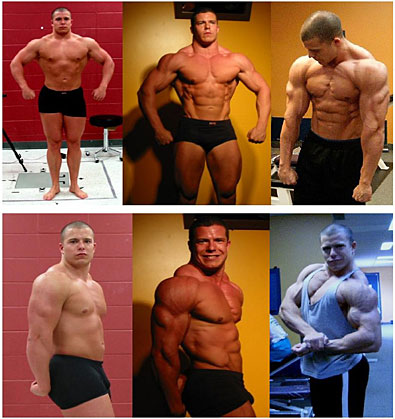
The bottom line I've gleaned from training oh so many years is that
functional strength just looks better
and being skinny helps show muscles. Most body sculpting is really high
maintenence because you have to balance all the various body parts with
isolation exercises or you look pretty lopsided. This can be done but
you'll be in the gym 4 hours
a day, no joke. Generally functional training just keeps your muscles
more balanced looking and you will look and be strong. I had
pooh-poohed hypertrophy training
until post-op after hip replacement surgery because I had to actually
grow
muscles (the so-called "butt project"). This blurb organizes (at
least I hope it does) my experiences. I thought I'd just put it all in
a webpage
and have done with it. It is good to know how to do this and how
it works.
So how much muscle can I actually gain?
Let me guess, you just read up on a program that offers to pack 40 lbs of
muscle on in a month, right? Hang on there for a sec before you sign up...
You must make a difference between weight and muscle. In a
highly conditioned athlete, as much as 40% of the muscle is glycogen, a form of sugar.
A lot of programs
will claim you can gain a ton of muscle in a month but that is really rubbish.
Really. Here is the lowdown on what happens. When you train hard you damage muscle
which is replaced with stronger muscle. This rate at which this happens
is called protein turnover and for human muscle (regardless of gender) this
takes about 180 days or 6 months. That is right. To completely change how a muscle is
put together takes at least 6 months. Studies on very strong people (this is important)
show that about the maximum anyone can gain runs at theoretical limit of about an ounce (25g)
per day (about 24 lbs/year), over their whole body. This works out to a few grams for even the largest muscles.
The actual maximum sustained observed amount was about 18 lbs in a year. A year is a really
long time to be on a training program like that so the max is probably only attainable for a little while.
Note that the amount of muscle you can grow is proportional to the amount present
(yeeee-haaaa a first order differential equation!). The people in these studies were normally
top-notch athletes who have a large amount of muscle to begin with, and knew how to
lift correctly so they could maximize gains. A more reasonable amount
(what I have sustained for several months) is roughly .5 - .75 lbs/month -- and this takes into account
gaining fat, water weight and whatever else. I am just talking about pure, verifiable muscle.
Another issue here is not just that gaining muscle takes time and hard work, but there is a learning
curve in getting your body ready and able to do this. It requires good technique in the lifts and diligence
in their performance. You will do nothing much if you work like everyone else, i.e., head to the gym for
a few weeks to "get stronger" and kinda sorta pick up stuff, then quit,
although you could end up sporting a major injury.
Most of the progress people see in that case is neurological in origin, meaning that after a few weeks
their central nervous system is finally starting to operate at a sufficiently high level to get some work done.
(This effect is more pronounced the less physically active you have been and it is well known among trainers
that a client of this sort can get major gains in all their lifts from even riding a stationary bicycle for a bit.
All is because they are so neurologically inactive that they can't even figure out how to turn the muscles on
voluntarily. A simple repetitive movement that they can do will make their central nervous system start to
operate.)
A neurological increase is faster than growing muscle and this is point at which most people declare victory and move one.
To get serious growth is a multi-month if not year program. Getting really big (like one of the pro body builders) will
take up to 5 years of sustained, hard training -- it takes time to gain 50 - 60 lbs. of quality muscle.
There are no shortcuts here. Anyone who is "hyoog" has put in serious training and time.
A few definitions
To get the ball rolling here, you should be prepared to do a little
bookkeeping and math. Your total work
for a given exercise is the product of the weight and the number of
repetitions. So if I do 25 reps of 100 lbs. I have done 2,500
lbs. total work for that exercise. (OK, we could get carried away and
figure the distance to get the actual textbook definition of work. We
could even divide by the amount of time to get the power used, but
c'mon, I'm trying to keep it simple.) Calculating lifting
poundages best to do per
exercise.
The baseline for movement is with no weight and if upping the weight to
the point you cannot do a full range of motion for a set occurs, you
are losing a functional training effect. Never sacrifice form, since
bad form just means some other muscles are doing the work rather than
the ones you want. Moreover, this means you are teaching your body that
when the loads get heavy, you have to do something other than the lift.
Think about that. Your last couple of crappy reps offsets any careful prep work.
If you're sloppy, drop the poundages
before you get hurt. Also, be aware of the difference between compound and complex
exercises. You should stick with simple taiso movements while you are doing
a hypertrophy phase and then go back to complex exercises.
Strategic deconditioning is
where you essentially back off of whatever plan you are using. You have to do this. You grow
between workouts, not during them!
The reason deloading is required too is
that muscles respond not to absolute load, but relative load. If you
take some planned time off between hypertrophy methods, you will grow
more muscle. So, if you have hit the end of a hypertrophy
cycle, starting a new one should mean you drop the poundages back down.
Good strategy is to look at your total work for an exercise and snake
that down, since just looking at reps and poundages can be misleading.
Remember that nobody has a good explanation as to why you can't just
gradually increase loads for a few years and end up benching a couple
of tons. In effect, the body is marvelously adaptive and this is
the most important survival ability we got from Evolution.
Once the body quits adapting, you are left with relative changes
rather than absolute ones. One thought is that one of the times I
looked huskiest was when I switched from using weight machines to
freeweights (immediately post-op). This lasted
a few months until my body adapted so that
even though I am now lifting easily twice what I was then, I got
physically quite a bit smaller for a while. Also in practice life interferes with
training so building in peaks and valleys to your training lets you
regulate better what you do, rather than having your plans thwarted by
work, family and other obligations.
nRM n-repetition max. The
number (n) of repetitions you can do of a given exercise at a given
load with proper form. So if you can lift 100 lbs. 8 times but would
fail on your ninth try you 8RM for that exercise is 100 lbs. Note
that I don't advocate going to real failure, just estimate it.
There are calculators for your one rep max available online. Use
these by finding a load you can lift more than a few times but less than
10 and lift until you don't think you can do another rep
with good form. Plug in your numbers. Trying to directly
find your one rep max is apt to be a sadly memorable affair if it
goes wrong on you.
Training Myth #397: Going to failure on lifts
is the best way to get bigger/strong/faster
Truth: Going to failure will screw up every subsequent lift and
you can lose ground. People are confusing the intensity of the training
with its merits.
How does hypertrophy training work?
In a nutshell, you must have some form of progressive
overload, whereby the total work is increased according to some plan.
This typically takes one of three forms either
- lifting high weight with low repetitions
- lifting medium weights with lots of repetitions
- decreasing the time between sets.
The first will increase the contractile proteins in the muscles making
you stronger and is the only way to actually grow these. While these
will thicken, it won't probably be enough for folks to see so you'll
get strong but not bigger -- think gymnast. The second
will increase the sarcoplasm which is just
scar tissue in the spaces between the contractile proteins. In this
case this can get you bigger, but you might
even find you have lost the ability to lift higher loads. The
final will give you an increase in endurance (= more mitochondria in
the cells) plus a mixture of one of the first two depending on the
amount of weight and reps you
use. If you want to get stronger, do 1, if you want to bulk
up, do 2. Since they both grow the muscles albeit in different ways,
they are both hypertrophy methods.
Which
method should I use? All of the ones outlined below.
Remember that your body will adapt after about 4 - 6 weeks. Therefore,
do
not plan on sticking with one of these for much longer than that. A
lot of people claim that this that or the other method is the absolute
best. Having played with a bunch of them, they really all follow the
same pattern of being effective for some time followed by hitting a
plateau. No exceptions. Many online authors have been stuck on a
plateau for some extended time and finally actually try something new.
Sure enough, it works great and they breathlessly write up something
about it with all sorts of numbers to prove it is the ultimate.
Aren't
these methods just for weight training? Well in theory,
yes, but
I use them for bodyweight exercises too. The nRM numbers below do
indeed refer
to weights and at least for the first time through you should stick to
weights rather than bodyweight since it is easier to gauge how you are
progressing, plus there are few good ways to get only part of your
bodyweight. Once you get
a feel for it though mix and match is the order of the day, For
instance, I do side presses alternating with pull-ups (start working on
your one-armed pullups if you want to work with a higher load). By the
same token one-armed pushups vs. rows are good as are pistols vs.
stiff-legged deadlifts. You could even do
two partner drills if you've got a buddy who wants to work.
How
often do you do this? I like to train body parts more
often than most people. It's gospel in some circles that you should
only do a part once a week or some such. Nope. I try to hit everything
3 times a week for this type of training.
What
exercises should I do? You should always train opposing
motions. Remember,
I do not "do" muscles I only train movements since I have a strong
requirement for functional strength. The last thing I want is
some sort of training that will increase my chances of getting
hurt. Oh, stick with the same basic exercises for all of these.
Small variations are a good thing, e.g. one good suite of exercises is to
alternate deadlifts with rack pulls, high pulls (aka jump shrug, but
don't leave the floor!) and various grip RDLs. Some of these you cannot
go nearly as heavy on as others and that is a good thing. Key point is that
strength is a skill. Have some basic movements you train for strength
and get very good at them. As long as they are large-scale compound
exercises (pretty much everything in taiso
is anyway) and you can do them (so no joint pain, for instance)
don't
bother looking at other variations. For instance, thanks to an
old shoulder injury, I can only do (one-armed) pushups or
dumbbells chest presses. Standard barbell chest
presses make my should hurt because the actual motion is not
anatomically quite correct. What I do is more than sufficient and I
can assure you that doing a chest press I have excellent poundages, but
why give myself a chronic condition?
How much and what
should I eat? You'll get a bit hungrier and your metabolism
will be higher. Plan on an extra 250 - 500 or so calories a day,
depending on how much you do and your size. Protein powders and weird
supplements are not encouraged and I don't use them much, though they
are very helpful if you get stuck without a meal. Oh, timing is
everything. Have a snack (better, a meal) ready as soon as you finish
your workout. This should be reasonably high in protein and complex
carbohydrates. Thinks like a candy bar or donuts are a no-no. (Although
right after a serious cardio session this can be fine since your body
will take and carbs and stick them back into the muscle. One remembers
the Olympic sprinter who swore by pizza with mayonnaise on it post
workout.) This does
two things, first it will stabilize blood sugar so you don't feel so
tuckered, secondly as a consequence it will regulate the amount of
insulin, which is a hormone needed to spur growth and finally your body
will get the message that it can grow. This sort of training is
actually damaging the muscles in a certain way and by not eating, the
body will tend to cannibilize resources unless it knows it has
sufficient food not to do that. It is gospel in many powerlifting
circles that cardio will counteract lifting. Sort of. If you do heavy
aerobics, for instance,
you can largely offset your strength training, but this takes a lot of
aerobics mind you, like running 50 - 60 miles a week. If you run that
much you probably also just don't have time to lift too. One of the
worst strategies you can adopt, by
the way, for losing weight is trying to do hypertrophy training while
seriously cutting calories. The muscles you train will certainly not
weaken, but the extra protein has to come from someplace and that means
anything you aren't using. Gain size and then if you need to lose
weight, do so separately. If you plan on doing hypertrophy training and
aerobic conditioning, do the weights first so you are not too tired. It
is even better if you can have a break of some hours between them to
allow for recovery. Don't lift when tired since a mistake can get you
hurt.
Major hypertrophy methods and how to do them
There are several methods I've tried and they all work. These are
listed in no specific order. The number refers to the list above. Note
never ever go to failure on any exercise. Some people say it's ok to do
so on the last rep of the day, but this just teaches your body to
fail.
If you want to really bulk, do each one for a month, then repeat.
Again, for taiso
type training, strength is a skill to be maintained so you want to find
a comfrotable plateau. Hypertrophy training is a great way to get a
change and get a different plateau.
Wendler's 5-3-1 protocol
Overload mechanism (1):
Having a planned increase in load weekly. This is a good protocol to
use to get really strong because it has good(=safer at high loads)
ideas about how to decrease reps as you increase the load
Main idea:
Choose a big bang lift, like deadlift, bench press or squat. Figure
out your loads and stick with the program. You increase the load for
3 weeks then have a fourth deload week build in.
How to do it: Figure your 1RM
for an exercise. Take 90% of that, called your target.
All percentages are calculated from the target!
| Week 1 |
Warmup |
75% x 5 |
80% x 5 |
85% x 5 |
| Week 2 |
Warmup |
80% x 5 |
85% x 3 |
90% x 3 |
| Week 3 |
Warmup |
75% x 5 |
85% x 3 |
95% x 1 |
| Week 4 (Deload!) |
Warmup |
60% x 5 |
65% x 5 |
70% x 5 |
Notes: Sets refers to actual
work sets. Do however of whatever you deem necessary to warm up first.
Do not just launch into the heavy stuff cold since that is asking for
a serious injury. It is fine to repeat the sets that are not max if
you want/need to. If I feel a bit slow I will do this to make
sure I am good and ready for wat comes next.
If you really feel amped, you can keep going on the
last set. So if the last week
you have done your set of singles and want to do a couple of more, go for it.
Escalation Density Training (EDT)
Overload mechanism (3):
Increasing the per session number of reps done
in a given amount of time and weekly increasing the load.
Main idea: Keep the time you
train constant. You increase either the number
of reps or amount of weight in a session..
How to do it: Figure your 6RM
for an exercise. Start with sets
(depends on you) of three rep for the first workout, then 4 reps then 5
reps. Increase the weight by 5% and start the cycle over again with the
same number of sets and 3 reps per set.
Notes: You are on the clock for
this one. The idea is to do more exercises within a given time period.
Remember this one if you work on a project with a deadline. It
really helps to block out a fixed amount of time and hustle to get it
all in.
German Volume Training (GVT)
Overload mechanism (2): Huge
numbers of repetitions, small weekly
increases in weight
How to do it: Figure your 20 RM
(you read that right). Your goal is to
complete 10 sets of 10 (for lower body) or 10 sets of 6 reps (upper
body). Every week increase the load by 5%.
Notes: This is really high
wear and tear but it also really does work. I plan on doing something
like this
over the summer or at Xmas when I am on vacation and have no martial
arts to do and limited weights available. The reason is that I
won't be
doing anything else and I can usually scrounge up the lower weights
needed at some random gym or hotel. Since this offers a real
prospect of overtraining injury if
(note that word!!) you do it while working out in other
sports, it's in a special category of high-risk. It is
perfectly fine if done alone though. Mind you,
what I'm saying: This is a lot of work and all by itself for a month is
great, just don't plan on doing much else for training since it also
takes a
lot of time to do all those reps.
Robertson's Volume Training (RVT)
Overload mechanism (1):Working with
lots of smaller sets at higher weights.
How to do it: Find a weight you can lift
with good form (say start light, then add until your reps drop) until you
can only do 3, a triple with good form. Drop the weight by 5%
and do as many sets of triples that day as you can. When you are no longer able to
lift the triple with good form, stop. Be honest too. Do this weekly for 3 weeks
and a deload down to 8 reps per set for the fourth week.
Notes:Kicks butt, yours, mine and
probably the guy's down the hall too. Only use on really big bang lifts
(deads and DB bench press are my personal favorites). You should "rest"
with supplementary exercises. So for instance between deadlifts I do side bridges
or wood choppers, then after a few sets of those, stability ball hamstring curls,
prone jack-knife on a stability ball of TRX blast strap.
The major difference between this and German volume training are the vastly higher
loads and fewer reps overall. GVT gives bulk if you just need to get something
larger (which is useful after an injury to restore size to something and not max
out whatever it was). RVT will get you seriously strong and you should eat like a horse
too with both of them.
5 by 5's (5x5)
Overload mechanism (1):
How to do it: Find your 5 RM.
Try to do 5 sets of 5 reps for each
exercise. Once you can do a workout fully increase the load by
5%.
Notes: that you probably won't
be able to complete the sets the first few times. Only increase the
weight
when you can do 5x5, i.e. all
five sets at 5 reps.
Cycling
Overload mechanism (1): Adding
more weight on a per session basis, but dropping the weight in a
regular timetable.
How to do it: Find an exercise
you like. Add 5% weight every other session for 6 sessions
running, then drop back a notch. So if you are lifting, e.g., 50 lbs., you would train
sessions 50 - 50 -
52.5 - 52.5 - 55 - 55 then restart as 52.5 - 52.5 - 55 - 55 - 57.5 -
57.5. Do this type of cycling for
4 weeks.
Notes:Another good method that
works. If you max out on a cycle (so you can't lift the top level
weights) drop back down or switch methods.
One rep training
Overload mechanism (1): Lifting
almost the maximum you can in a single
rep, but doing this several times in a workout.
How to do it: Find your 3RM. Do
5 or 6 single reps with no more than 15
seconds between them.
Notes: Warm up well with lower
weight before you do
this. Not suggested for folks with a bad joint. In my case I
would not do a chest press type exercise with this method since the
load exacerbates an old injury.
Final comments
One way of doing this might be to change over all of your exercises, so
you are doing the same mechanism for everything. This is a great way to
get big and strong, but tends to be a lot of work. Try it every so
often. Body sculptors obsess about this since they have to have
everything come together for a competition. You don't have to do this,
so you can mix and match any way you want.
These are all pretty standard in various weightlifting communities.
They actually are implicitly subsumed in taiso. The way that, for
instance, one is to work on an exercise is to take a workout goal (e.g.
10 one-armed pushups) and do a random one or two of these in the course
of a workou until the
goal is attained (this is exactly one rep training). Then you try to do
smaller sets of these, say 3 or 4 in a row (a lot like 5x5's) and the
goal is then to be able to do several of these more or less back to
back (escalation density training). Finally working these into a
program where you do many sets of these over the course of a session
(high volume training). None of these methods were articulated, it's
just good common sense. Once you are comfortable, you put these into
complex exercises, do them plyometrically, &c.,
&c. the point being that aleatoric training is the way to maintain
these as a skill (this often ends up as cycling). Nice to know there is
independent corroboration of its efficiacy plus a coherent explanation
of the mechanisms.